Root Canal or Implant: The Decision Most People Make in the Wrong Order
This decision usually gets made badly, and the reason is structural: it gets made while you are in pain, on short notice, often by phone, and frequently with only one of the two options presented.
Both directions of error are common. Patients spend money saving a tooth that was never salvageable and lose it anyway two years later. Patients extract a tooth that had years left because “an implant is permanent” and extraction is faster.
Here is the framework that avoids both.
The default, and why it exists
A natural tooth that can be predictably saved is generally worth saving. This is the consensus starting position, and it is not sentimentality about keeping your own teeth. There are specific reasons.
The periodontal ligament. A natural tooth is not fused to bone. It is suspended in a ligament with its own blood supply and, critically, its own nerve supply. That ligament contains pressure receptors that tell your brain how hard you are biting, dozens of times per second, and it lets the tooth move microscopically under load rather than transmitting force rigidly into bone.
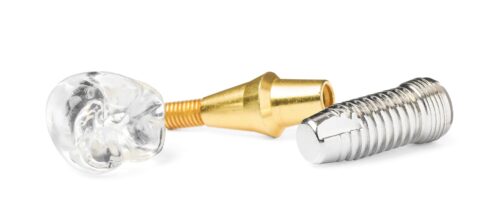
An implant has none of this. It is fused directly to bone. It works extremely well and it does not feel the way a tooth feels, because the sensory apparatus is not there. Patients with implants routinely report they cannot judge bite pressure on that side the way they can on a natural tooth.
The immune interface. That same ligament carries immune response to the site. It is a large part of why a natural tooth resists infection differently than an implant does, and why peri-implantitis behaves as aggressively as it does once it starts.
Surgery avoided. Root canal treatment is a non-surgical procedure performed through the tooth. An implant requires extraction and surgical placement, and often grafting.
The sequence is one-directional. A tooth that has been treated endodontically and later fails can still become an implant. A tooth that has been extracted cannot become a tooth again.
When the implant is the better answer
The default is a default, not a rule. There are clear situations where saving the tooth is the more expensive path to the same outcome.
Vertical root fracture. A crack running lengthwise down the root is generally not repairable. This is the most definitive indication for extraction.
Insufficient remaining structure. After decay and previous restorations, a tooth needs enough sound structure above the gum for a crown to grip — clinicians refer to this as the ferrule. Without it, the restoration has nothing to hold onto and will eventually come off, taking the tooth with it.
Advanced periodontal bone loss. A tooth with a perfect root canal and inadequate bone support is still a tooth that is going to be lost. Endodontics addresses the inside of the tooth, not the foundation around it.
Failed retreatment. When a root canal has already been redone and the infection persists, and surgical options have been exhausted, the tooth has told you what it is going to do.
Non-restorable decay. Decay extending well below the gum line, where a margin cannot be established.
Unfavorable anatomy or a strategically unimportant tooth. Occasionally the honest calculation is that a heroic effort to save one tooth compromises the plan for the rest of the mouth.
The variable that changes the comparison
Patients compare the cost of a root canal against the cost of an implant and conclude the root canal is dramatically cheaper. That comparison is incomplete in one important respect.
A root-canal-treated tooth almost always needs a crown, particularly a molar or premolar. The treatment removes internal structure and the remaining tooth becomes considerably more prone to fracture without full coverage. A root canal without the crown that follows it is an unfinished treatment, and fracture after an untreated root canal is one of the more avoidable ways to lose a tooth.
So the real comparison is root canal plus crown, against extraction plus implant plus crown. The tooth-preserving path is still generally the less expensive of the two, but the gap is narrower than the headline numbers suggest, and knowing that in advance prevents the unpleasant discovery that the treatment was not finished.
Both paths also have failure modes. Root canals fail, usually because a canal was never located. Implants fail, usually from bone loss around them. Neither is a guaranteed permanent solution, and any clinic presenting either as one is overstating what dentistry can promise.
Why microscopy changes the odds
The most common reason a root canal fails is a canal that was never found. Molars routinely have four canals and sometimes more, and the additional ones are frequently too narrow to see with the naked eye. Untreated canal tissue is untreated infection, and it resurfaces later.
Under a surgical microscope at high magnification, those canals are visible. That is the practical difference between a treatment that resolves the infection and one that leaves part of it behind. It is also why retreatment — reopening a previously treated tooth — is a harder procedure than a first treatment and warrants the same magnification.
If you are weighing a root canal against extraction, the quality of the endodontics available to you is a legitimate input into that decision. A tooth that would be a poor bet with one approach may be a reasonable bet with another. Our page on microscopic root canal treatment covers what that involves.
The middle option that often gets skipped
When a previous root canal has failed, the choice is frequently presented as extract-and-implant. There is usually a step in between.
Endodontic retreatment reopens the tooth, removes the previous filling material, locates any missed canals, and re-treats and re-seals the system. Apicoectomy is a surgical alternative that treats the root tip directly when retreatment through the crown is not viable.
Neither is appropriate in every failed case. Both should at least be evaluated before a tooth is extracted, because extraction is the only step in this sequence that cannot be undone.
What a red flag looks like
A clinic whose default recommendation for compromised teeth is extraction and implants deserves scrutiny. The implant is the higher-revenue procedure and the faster one, and that combination creates a bias that does not need to be malicious to be real.
What you should receive is a specific reason. Not “the tooth is bad,” but which finding, visible where, makes it non-restorable. Fracture line, bone level, remaining structure, previous treatment quality. If the reason cannot be stated specifically and shown to you, a second opinion is warranted — and any competent practice will say the same.
Frequently asked
Is a root canal painful?
The reputation comes from the infection, not the procedure. By the time most patients arrive, the pain is at its peak and the treatment is what ends it. Under modern anesthesia the procedure itself is broadly comparable to having a filling placed. Soreness for a day or two afterward is normal and manageable.
How long does a root-canal-treated tooth last?
Well-treated and properly crowned, many function for decades. The dominant variables are whether all canals were located and sealed, and whether the tooth was protected with a crown afterward.
Can a root canal be redone if it fails?
Frequently, yes. Retreatment and apicoectomy are both established options, and both should be assessed before extraction is chosen.
Is an implant stronger than a natural tooth?
Mechanically it is very strong. But it lacks the pressure feedback a natural tooth has, which means patients can apply forces to it that they would not apply to a tooth, and that is a factor in long-term restoration wear. Stronger is not the same as better.
How quickly do I have to decide?
Active infection needs treatment on a real timeline. The choice between saving and replacing, however, is worth an extra day and a second opinion if you are uncertain, because one of the two options is irreversible. An urgent situation can usually be stabilized first and planned properly afterward.
If you have been told a tooth cannot be saved and want that assessed by an endodontist rather than assumed, that is a specific question worth a specific answer. Our contact page is where to send imaging and start the conversation.
Related reading: Microscopic Root Canal in Tijuana · Dental Implants in Tijuana · How long do dental implants last?