
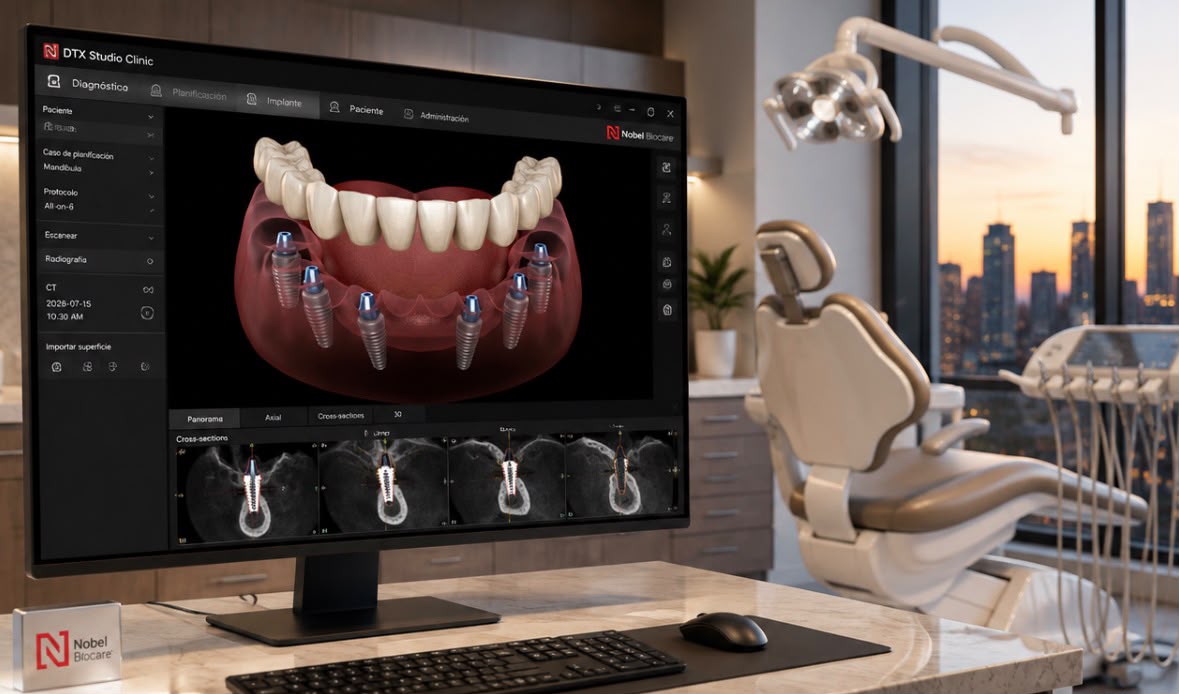
All-on-4 vs All-on-6: How the Decision Is Actually Made
If you are reading this, you have already passed the hardest part of the decision. You know the arch is failing, or already gone, and you know you want something fixed rather than something you take out at night. What is left is a number, and the way the industry presents it makes it sound like a product tier — four for the basic version, six for the good one.
It is not that. The number of implants is a clinical decision driven by how much bone you have, how hard you bite, and how long the arch is that needs support. In some patients four is correct and six would be over-treatment. In others four would be under-engineered and would eventually show it.
Here is what actually separates them.
What the two approaches share
Both are full-arch solutions. Both replace an entire upper or lower arch with a single fixed bridge that is carried by implants rather than resting on gum tissue. Neither is removable by the patient. In both, the bridge is anchored to implants that have integrated with the bone, and in most cases a provisional fixed bridge can be placed the same day the implants are placed.
The philosophy is identical: instead of one implant per tooth, a small number of well-positioned implants carry a bridge that spans the arch. That is why the number of teeth you end up with has nothing to do with the number of implants.
What the two additional implants change
Three things, and they are all versions of the same idea: force.
Load distribution. Six points of support mean each implant carries less of the chewing force than it would if there were four. Over decades, that matters.
Posterior extension. The additional implants can be positioned further back along the arch, which allows the bridge to extend further back without a long cantilever. A cantilever is the unsupported portion of the bridge that hangs past the last implant. Every full-arch design has some, but the longer it is, the more leverage it applies to the implant closest to it.
Molar function. The strongest bite forces in the mouth are generated at the back. A bridge supported further back handles those forces differently than one supported further forward.
None of this makes six automatically better. It makes six better for a specific set of anatomies.
The case for four
The four-implant approach works because of angulation, not despite it. Two implants are placed toward the front of the jaw where bone is densest, and two are placed at an angle toward the back. Tilting those posterior implants does two useful things at once: it engages more bone along the length of the implant, and it moves the point of support further back without entering the maxillary sinus above or the nerve canal below.
That is the reason many patients who were told they needed extensive bone grafting turn out not to. The technique works around the existing anatomy rather than rebuilding it first. For a patient who wants to avoid a grafting phase — which adds months to the schedule and a second surgical procedure — that is not a minor advantage.
Four implants also means two fewer surgical sites, which means less healing, and it means a lower cost. Both of those are real benefits, not consolation prizes.
The case for six
Six becomes the better answer when the anatomy supports it and the mechanics call for it.
Bone volume allows it. This is the first gate. Six implants require more available bone than four, in more locations. Imaging decides this, not preference.
The arch is long. More posterior support means a longer bridge with less cantilever.
Bite force is high. Bruxism, a heavily developed masseter, or a natural opposing arch of real teeth all increase the load on the bridge. A patient whose lower arch is full of healthy natural teeth generates more force against an upper bridge than a patient with dentures opposing it.
It is the upper arch. Bone in the upper jaw is generally less dense than in the lower, and the sinus limits where implants can go. Additional support is more often indicated above than below.
What should not decide it
Price. If your anatomy calls for six, four will be the more expensive decision over fifteen years. If your anatomy does not, six is money spent on surgical sites that were not needed.
A clinic’s default protocol. Some practices place four in nearly everyone and some place six in nearly everyone. Both patterns are a sign the decision is being made before the imaging.
What a friend had done. Bone volume is not shared between people who had the same problem.
When four is enough, we say so
We put this plainly because the industry often does not: if your bone volume, arch length and bite do not call for six, four will serve you just as well. Two fewer surgical sites means less healing and lower cost, and there is no clinical reason to add implants a case does not need.
The number of implants is a clinical decision, not a product tier. What you should expect from any consultation is not just a recommendation but the imaging that drives it, shown to you, with the reasoning attached.
What the process looks like either way
Diagnosis comes first: three-dimensional imaging, bite analysis, and a written plan stating the number of appointments and the timeline. Remaining compromised teeth are removed and the implants placed in the same session, one arch at a time, with sedation available. A provisional fixed bridge is fitted in most cases the same day, so you do not leave without teeth.
Then healing. Integration typically takes three to six months, during which a soft diet is required for the first several weeks. The final bridge is made and fitted only after integration is confirmed.
For patients crossing from San Diego, this usually means two trips with remote follow-up between them. The full schedule should be in your hands from the first appointment so the trips can be planned around your life rather than announced to you.
Frequently asked
Can I decide this myself before the consultation?
You can arrive informed, which is worth a great deal. But the deciding variable is bone volume in three dimensions, and that is not something you can assess from the outside. What you can do is arrive prepared to ask why the recommendation is what it is.
Is All-on-6 more painful than All-on-4?
Two additional surgical sites generally mean somewhat more post-operative soreness. Both are performed under local anesthesia with sedation available, and both typically involve several days of manageable discomfort rather than severe pain. Individual experience varies.
Can implants be added later if I start with four?
Not straightforwardly. The bridge is designed and fabricated around a specific implant configuration. Adding support later usually means a new prosthesis. This is one reason the decision deserves imaging rather than a guess.
What if I have bone in one arch and not the other?
That is common, and the two arches are planned independently. It is entirely normal to end up with a different number of implants above and below.
Do I need this at all, or would individual implants work?
That depends on how many teeth are involved and whether the remaining ones can be saved. If you are not certain you are a full-arch case, that question is worth answering first. Our article on how many implants you need covers the range between one tooth and a full arch.
Whether your case calls for four or six is a question the imaging answers, and it is worth answering before you plan a trip around it. Our contact page is where that conversation starts, and recent X-rays sent ahead often allow a preliminary opinion before you cross.
Related reading: All-on-4 Dental Implants in Tijuana · All-on-6 Dental Implants in Tijuana · Bone grafting before implants · How long do dental implants last?