How Many Implants Do I Need? Almost Never One Per Tooth
Patients arrive with a count in their head. Six teeth missing, six implants, and a number in mind that they have already decided is out of reach.
The count is almost always wrong, and usually in the patient’s favor. Implants replace roots, but a bridge can span between them — which means the number of teeth you end up with has very little to do with the number of implants underneath.
Here is how the number is actually determined.
One missing tooth
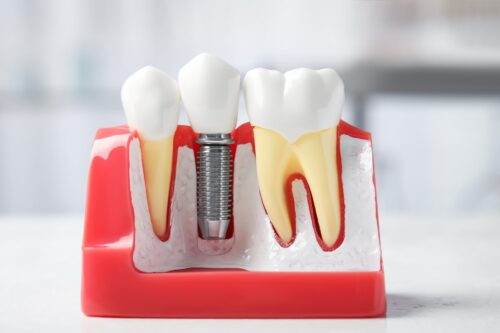
One implant, one crown. This is the straightforward case, and it is the one where the count matches intuition.
The alternative is a conventional bridge, which requires preparing the two adjacent teeth to carry it. If those neighbors are healthy and untouched, that is a significant cost to pay for restoring one gap. If they already have large restorations and would benefit from crowns anyway, a bridge becomes a more reasonable option.
Two or three missing teeth in a row
This is where the arithmetic starts to diverge from intuition.
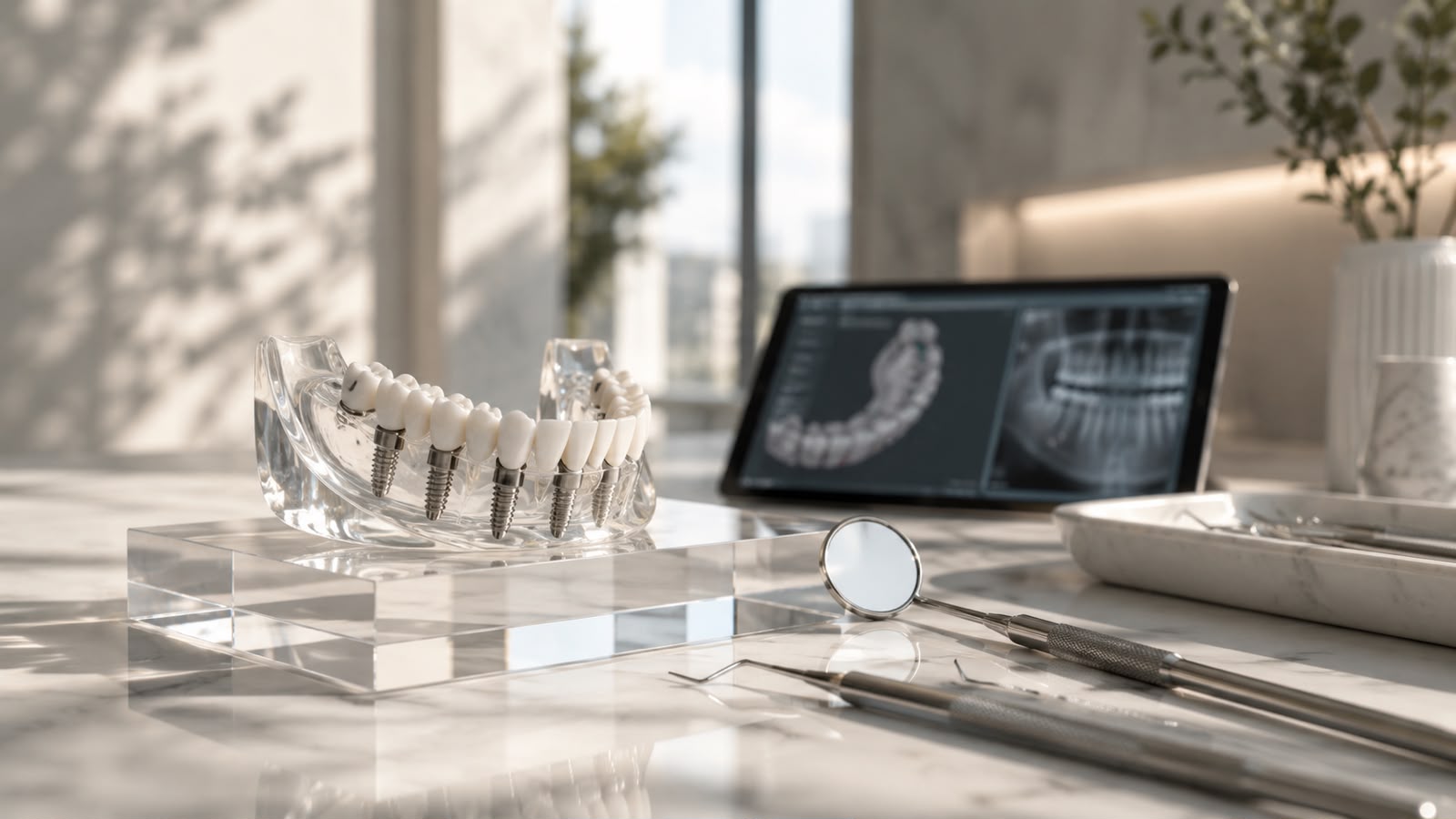
Two adjacent missing teeth can be restored with two implants, or in some situations with one implant and a cantilevered unit. Three in a row are frequently restored with two implants supporting a three-unit bridge — the implants at each end, the middle tooth suspended between them.
What determines it is bone at each site, the position within the arch, and the forces involved. A three-unit implant bridge at the front of the mouth and one at the back are different mechanical problems.
Several missing teeth, not adjacent
Here the plan depends on the pattern rather than the count. Scattered gaps sometimes require an implant at each site because there is nothing to span between. Sometimes strategic placement allows a few implants to support restorations covering more teeth than there are implants.
This is a case where the treatment plan needs to be drawn rather than described, and where the number is genuinely unpredictable before imaging.
A full arch, fixed
For a complete upper or lower arch restored with a fixed bridge that you do not remove, the established range is typically four to six implants per arch, occasionally more in specific circumstances.
Four is the basis of the All-on-4 approach: two implants placed at the front where bone is densest, two tilted toward the back to extend support without entering the sinus or the nerve canal. Six distributes chewing load across more points and allows the bridge to extend further back with less cantilever.
Which one your anatomy calls for is decided by bone volume, arch length and bite force — not by preference or by a clinic’s default protocol. We cover that decision in detail in All-on-4 vs All-on-6.
Twelve to fourteen teeth on four to six implants sounds implausible to patients hearing it for the first time. It is the standard of care in full-arch implant dentistry and it has decades of documentation behind it.
A full arch, removable
An implant-supported overdenture is a different category and a legitimate one. It snaps onto implants and is removed by the patient for cleaning.
The typical range here is two to four implants per arch. Two implants supporting a lower overdenture is a long-established and well-documented approach, and it addresses the single biggest complaint about conventional lower dentures, which is that they do not stay put. Four implants provide greater stability and better load distribution.
The trade-off against a fixed bridge is real in both directions. An overdenture requires fewer implants and costs less. It also covers more palate in the upper arch, is removed daily, and does not feel like fixed teeth. Neither option is the correct one universally, and a clinic that presents only one is presenting a product rather than a plan.
What actually moves the number
Bone volume. The first gate on everything. Insufficient bone means either grafting, or a design that works around what exists, or fewer implants placed in the sites that can support them.
Bite force. Bruxism and a heavily developed jaw musculature increase the load the restoration must survive, which argues for more support.
What is in the opposing arch. An upper bridge opposed by a full set of healthy natural teeth is under substantially more force than one opposed by a denture. This is a variable patients almost never consider and specialists always do.
Arch shape and length. A broad arch requires support further back than a narrow one.
Whether the result is fixed or removable. The single largest branch in the decision tree.
Hygiene access. More implants placed close together can be harder to clean around, and cleanability is directly connected to how long the work lasts.
Why more is not automatically better
Patients frequently ask whether they can add implants for extra security. Sometimes the answer is yes. Often the honest answer is that it would add surgical sites, cost and maintenance burden without improving the outcome.
Each additional implant is another surgical site to heal, another site that must be cleaned around for the rest of your life, and another site where peri-implantitis can start. In a design that is already mechanically sound, additional implants do not add durability proportionally.
The number of implants is a clinical decision, not a product tier. If your bone volume, arch length and bite do not call for more, fewer will serve you just as well — and that is what we will tell you, including when it means a smaller treatment plan than the one you arrived with.
Why nobody can answer this over the phone
The determining variable is bone volume in three dimensions, and it is not visible from the outside, not visible in a photograph, and not adequately visible in a flat panoramic X-ray.
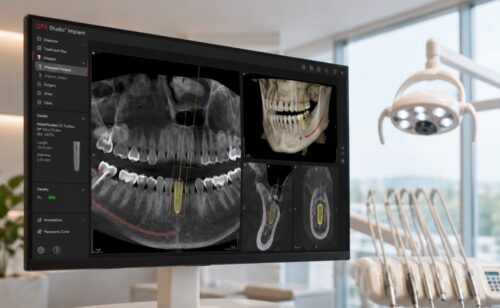
A CBCT scan shows height, width and density at every potential site, along with the position of the sinus and the nerve canal. That is what turns “you are missing six teeth” into “here is where implants can go, how many, and why.”
Any plan produced without one is a guess, and guesses in implant dentistry are corrected surgically.
Frequently asked
Can I do this in stages if the full plan is not feasible now?
Sometimes, and it depends heavily on the design. Some plans are naturally sequential — one arch, then the other. Others are not, because the prosthesis is engineered around a specific implant configuration and cannot be expanded later. This is worth asking explicitly at the planning stage rather than discovering afterward.
If I lose more teeth later, can implants be added to an existing bridge?
Generally not to an existing full-arch bridge, which is fabricated for a fixed configuration. In partial cases with individual restorations there is usually more flexibility. It is one of the arguments for planning the whole mouth even when treating part of it.
Is it possible to have too few implants?
Yes, and it is a real failure mode. Under-supporting a long span concentrates force on the implants that are there, which shows up over years as bone loss around them or as fractured prosthetic components. This is the reason cost should not be the variable that sets the count.
Do I need one implant per tooth for a full arch?
No, and it is neither standard nor advisable. Twelve to fourteen individual implants per arch introduces hygiene, spacing and mechanical problems that a well-designed four-to-six implant bridge does not have.
What if one arch needs more than the other?
Entirely normal. The arches are planned independently, and the upper frequently requires a different approach than the lower because bone density and anatomy differ.
The count for your case is a specific number that comes out of a scan, and it is often lower than the one you arrived with. Our contact page is where to send existing imaging for a preliminary look before planning a trip.
Related reading: Dental Implants in Tijuana · All-on-4 vs All-on-6 · Bone grafting before implants · Cost of dental implants in Tijuana