Bone Grafting Before Implants: How to Tell If You Actually Need One
You went in for an implant and came out with a second procedure, a longer timeline and a higher number. It is a reasonable moment to be suspicious.
Sometimes that suspicion is warranted. More often the recommendation is correct and was explained badly — because the underlying fact is one nobody tells you when the tooth is extracted: bone that is no longer holding a tooth does not stay where it was.
This is what is actually happening, and how to check whether the recommendation you received holds up.
Why the bone disappears
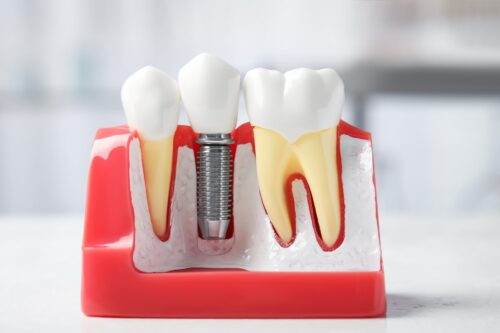
Bone is not a static structure. It remodels continuously in response to the forces applied to it, and the force that maintains the bone around a tooth root is chewing, transmitted through the periodontal ligament.
Remove the tooth and that stimulus stops. The bone in that socket begins to resorb, and it resorbs fastest in the first months after extraction. The ridge narrows and loses height. This process is well documented and it is why a tooth lost ten years ago presents a different surgical problem than one lost last month.
Two consequences follow.
First, the sooner an implant or a socket preservation graft happens after extraction, the less bone is likely to be lost. This is the strongest argument for planning the replacement before the extraction rather than after.
Second, if you have been missing teeth for years, some volume of bone has almost certainly gone. That is not a sales tactic. It is the expected finding.
What a graft actually is
A bone graft is material placed at the site to give your body a scaffold to build on. The graft itself is not the finished product — over months, your own bone grows into and eventually replaces most of it. The scaffold holds the space while that happens.
The types you may be quoted
Socket preservation. Graft material placed into the socket immediately after an extraction, to limit the collapse before it occurs. The least invasive version, and the one most easily avoided by not planning ahead.
Ridge augmentation. Rebuilding width or height of a ridge that has already resorbed, so an implant of adequate dimensions can be placed.
Sinus lift. Specific to the upper back jaw. The maxillary sinus sits above those roots, and when upper molars are lost the sinus floor tends to expand downward into the space. A sinus lift raises the sinus membrane and places graft material beneath it to create enough vertical bone for an implant. It sounds alarming and is a routine, well-documented procedure.
Block graft. A larger reconstruction for significant defects, using a block of bone secured to the site. Less common, more involved, longer healing.
The materials
You are likely to hear four terms, and they are worth understanding because clinics rarely explain them.
- Autograft — your own bone, taken from another site. Long considered the biological benchmark, at the cost of a second surgical site.
- Allograft — processed human donor bone from a tissue bank.
- Xenograft — processed bone of animal origin, most commonly bovine. Widely used and extensively documented.
- Alloplast — synthetic material.
Combinations are common, often with a barrier membrane over the site to keep soft tissue from growing into the space before bone does. None of these is universally superior. Which is appropriate depends on the defect, its size and its geometry, and it is a fair question to ask.
When you do not need one
This is the part worth reading carefully, because it is the part most likely to save you a procedure.
Tilted implants can avoid grafting in full-arch cases. The reason the All-on-4 technique angles its posterior implants is precisely to engage available bone and reach further back without entering the sinus or the nerve canal. A significant number of patients who were told they needed extensive grafting for a full arch do not, because the technique works around the anatomy rather than rebuilding it. Our comparison of All-on-4 and All-on-6 covers how that decision is made.
Implant dimensions can sometimes be adapted. Shorter or narrower implants are viable in some sites where a standard-dimension implant would not fit. This is a clinical judgement with real trade-offs, not a universal shortcut.
Grafting and placement are sometimes simultaneous. Not every graft means waiting months before the implant. When enough native bone exists for initial stability, grafting can often be done at the same appointment as placement, which collapses two procedures into one.
Some sites simply have enough bone. Especially in the lower front jaw, and especially when the tooth was lost recently.
How to verify the recommendation
You do not need to interpret a scan yourself. You need to see that one exists and hear the reasoning attached to it.
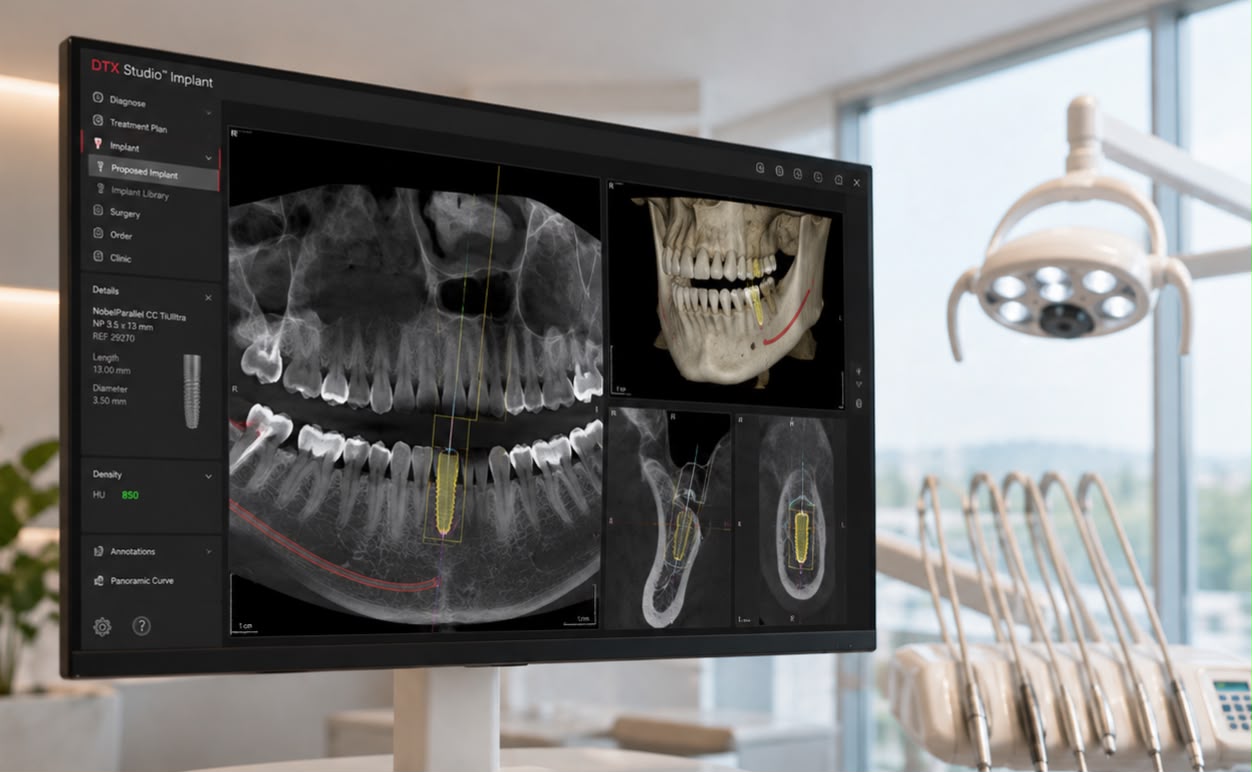
- Was the recommendation made after three-dimensional imaging? A graft recommended from a panoramic X-ray is a guess. A CBCT scan shows bone volume in three dimensions, which is the only way the question can actually be answered.
- Can you see the scan and have it explained? Insufficient width or height is visible to a layperson once it is pointed out. A specialist who is confident in the recommendation will show you.
- What happens if the graft is skipped? There should be a specific answer — the implant would not have adequate stability, or would be too short for the load, or would perforate the sinus. “It would be better” is not an answer.
- Is a simultaneous approach possible? Worth asking explicitly.
- What does it add to the timeline and the cost? In writing, before you agree.
A second opinion on a grafting recommendation is entirely reasonable and no competent clinic will be offended by it.
What it means for your schedule
For patients crossing from San Diego, grafting is primarily a calendar problem.
A graft that heals before implant placement typically requires several months between procedures, and the exact interval depends on the type of graft, its size and the site. That usually means one additional trip. Simultaneous grafting and placement generally does not.
What matters is that the full schedule exists in writing from the first appointment, so the trips can be planned around your life instead of announced to you one at a time.
Frequently asked
Is bone grafting painful?
It is performed under local anesthesia, with sedation available. Post-operative soreness and swelling for several days is typical, and the extent depends on the size of the graft. A socket preservation graft and a block graft are very different experiences.
How long before the implant can be placed?
When grafting is done separately, healing generally takes several months before the site can support an implant, with the interval determined by the graft type and size. Your specialist should give you a specific expected range for your case rather than a general one.
Can a graft fail?
Yes, though it is not common. Infection, insufficient blood supply and smoking are the main risk factors. When a graft does not take, the usual path is to allow the site to heal and repeat with a modified approach.
I was told by one clinic I need a sinus lift and by another that I do not. Who is right?
Both may be describing different implant plans. A shorter implant, a tilted implant, or a different position can change whether the sinus is a limiting factor. The productive question is not which clinic is right but what specific implant each is planning and why.
Is donor or animal-derived graft material safe?
Allograft and xenograft materials are processed to remove cellular and organic components and are subject to regulatory standards for tissue products. They are among the most widely used materials in implant dentistry worldwide. If the origin of the material matters to you for personal or religious reasons, that is worth raising before treatment, because alternatives exist.
If you have been told you need a graft and want the reasoning shown to you on a scan rather than asserted, that is exactly what a diagnostic consultation is for. Our contact page is where to send existing imaging for a preliminary look.
Related reading: Dental Implants in Tijuana · All-on-4 vs All-on-6 · How many implants do I need?