Nobel Biocare vs Straumann: A Neutral Comparison
These two names come up more than any others when a patient starts researching implant systems, usually because a clinic mentioned one of them or because a forum argued about both.
This article is educational and independent. It is not an endorsement of either manufacturer, and it does not represent a commercial relationship with either. Its purpose is to explain what actually distinguishes them, so that a conversation with any clinic about implant systems is a more informed one.
Where each one came from
Both trace back to the foundational research in osseointegration — the discovery that titanium can fuse directly with living bone — and both have been in clinical use for decades.
Nobel Biocare has its origins in the Swedish research of Per-Ingvar Brånemark, whose work in the 1960s and 1970s established osseointegration as a clinical reality. Modern implant dentistry begins with that research.
Straumann, based in Switzerland, developed in parallel through the work associated with the ITI, an academic and research organization that has generated a substantial body of independent implant literature.
Both are among the most extensively studied implant systems in the world. Neither is a newcomer, and neither is an outlier in terms of evidence.
What genuinely differs
Surface technology
Each manufacturer has developed its own proprietary implant surface, and each has a body of research supporting it.
Straumann’s surfaces are widely known under the SLA designation, and the company later introduced a chemically modified version marketed for accelerated integration. Nobel Biocare’s surface is marketed as TiUnite, an oxidized titanium surface with its own research history.
What these surfaces are competing over is primarily the speed and reliability of osseointegration, which matters most in compromised bone, grafted sites and immediate-loading protocols. In a healthy site with adequate bone, both integrate reliably.
Material
Straumann introduced a titanium-zirconium alloy marketed as Roxolid, engineered for higher strength than commercially pure titanium, which permits narrower-diameter implants in constrained spaces. Both companies also offer ceramic implant options.
Nobel Biocare works predominantly in titanium across its lines.
For most cases this distinction is not decisive. Where it becomes relevant is in sites with limited bone width, where a narrower implant of adequate strength can avoid a grafting procedure.
Connection design
Each system uses its own implant-abutment connection geometry, and each has multiple lines with different designs — Straumann’s tissue-level and bone-level families, Nobel Biocare’s several implant lines each with its own connection.
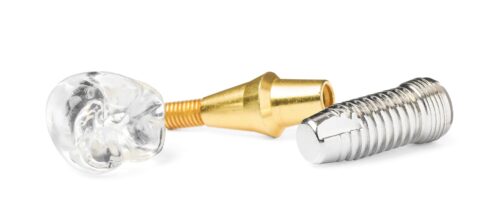
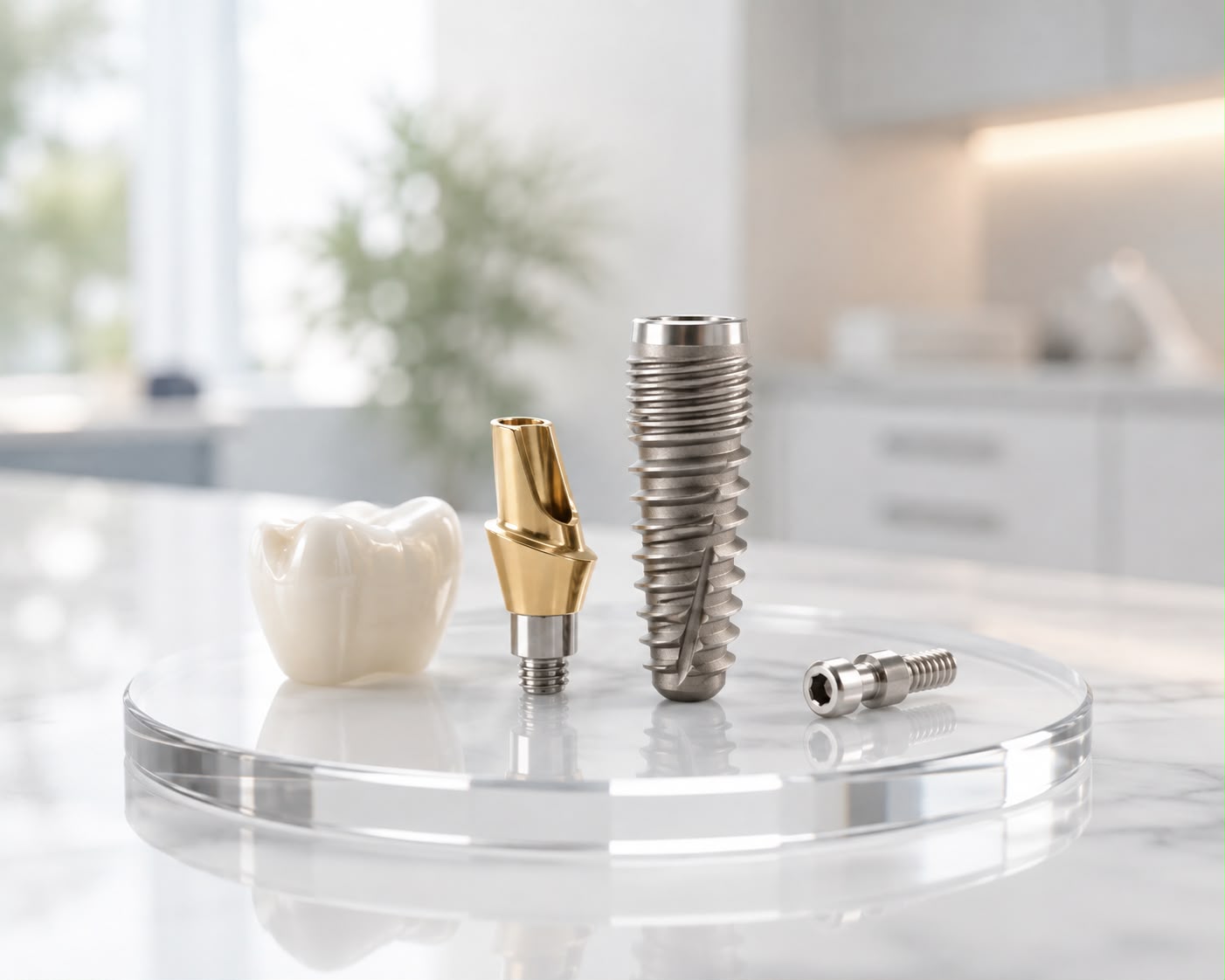
The clinically relevant point for a patient is not which geometry is superior. It is that the systems are not compatible with each other. Components from one manufacturer do not fit the other, and within each manufacturer, different lines may not share components either. Whatever is placed in your jaw commits the restoration to that manufacturer’s ecosystem for as long as the implant is in service.
The All-on-4 name
Worth clarifying because it causes confusion. The All-on-4 protocol was developed and trademarked in association with Nobel Biocare. The underlying concept — a full arch supported by four implants, with the posterior two tilted — has since been adopted broadly across the profession, and equivalent full-arch protocols exist within other systems including Straumann’s.
In practice this means a clinic can offer full-arch treatment on four implants using a system other than Nobel Biocare, and the terminology used will vary. If the distinction matters to you, the useful question is which system is being used, not which trade name is on the treatment plan. Our comparison of All-on-4 and All-on-6 covers the clinical decision itself.
What does not differ meaningfully
Clinical success in straightforward cases. Both systems have long-term documentation showing high survival in well-selected, well-maintained cases. Comparative studies between premium systems generally do not produce dramatic separations.
Global availability. Both are distributed worldwide, including throughout the United States and Mexico. Either can be serviced by a dentist in San Diego who has access to the manufacturer’s components.
Documentation depth. Both are in the top tier of research volume. This is precisely why they are the two most compared.
Price tier. Both are premium-priced systems. Neither is the budget option.
Why the comparison matters less than it seems
The variable that most determines the outcome of an implant case is not which of these two systems is used. It is whether the case was diagnosed with three-dimensional imaging, whether the implant was positioned for the restoration that will sit on it, who placed it, how the restoration was designed, and whether it is maintained.
An implant from either manufacturer placed at the wrong angle in insufficient bone is a compromised case. A well-executed case with either is a good outcome.
Where system choice genuinely earns its weight is in the harder scenarios: minimal bone width, immediate loading, grafted sites, and long-term component availability. Those are the situations in which the specialist’s familiarity with a particular system matters, and it is a reason to be cautious about requesting a system your surgeon does not use routinely.
We cover the broader framework in how to think about implant brands.
Questions that are more useful than “which brand”
- Which system and which specific line, and why that one for my anatomy
- How long the specialist has been working with it
- Whether components will be obtainable in the United States years from now
- Whether I receive documentation with the manufacturer, model, dimensions and lot number
- What happens if the restoration requires servicing while I am at home
A clinic that answers all five clearly is demonstrating something more useful than a brand affiliation.
Frequently asked
Is one of them better than the other?
Both are top-tier, extensively documented systems with different engineering philosophies. Independent comparative research generally does not establish clear superiority of one over the other in standard cases. The more meaningful variable is the clinician.
Are they interchangeable if I need work done later?
No. Components are manufacturer-specific and often line-specific. This is why keeping documentation of exactly what was placed is genuinely important.
Does either offer a lifetime guarantee?
Manufacturers publish their own warranty terms for the fixture itself, and those terms vary and change over time. A manufacturer warranty on a component is not the same thing as a clinical warranty from the practice that placed it, and the second is the one that affects you. That is a question to ask the clinic directly and in writing.
Should I refuse treatment with a system that is neither of these?
Not automatically. Several other well-documented manufacturers produce excellent implants. The questions worth applying to any of them are documentation depth and long-term component availability.
Which one is used at Makeover Dental Studio?
If you want to know which system would be used in your case and the reasoning behind it, that is a specific question with a specific answer. Our contact page is where to ask it.
Related reading: Dental Implants in Tijuana · Best implant brands · How long do dental implants last?