Invisalign vs Braces: The Question Is Biomechanics, Not Appearance
Almost everyone arrives at this comparison for the same reason: they do not want visible braces. That is a legitimate preference and it is worth taking seriously.
It is also not the question that determines the outcome. The question that determines the outcome is what each appliance can physically do to a tooth, because there are movements one performs reliably and the other struggles with, and no amount of preference changes that.
This article covers both honestly, including the parts of aligner treatment that are rarely mentioned in the advertising.
Note on terminology: Invisalign is a registered trademark of Align Technology and is the most widely known clear aligner system. Several other aligner systems exist. This article discusses the clear aligner approach generally and does not represent a commercial relationship with any manufacturer.
How each one actually moves teeth
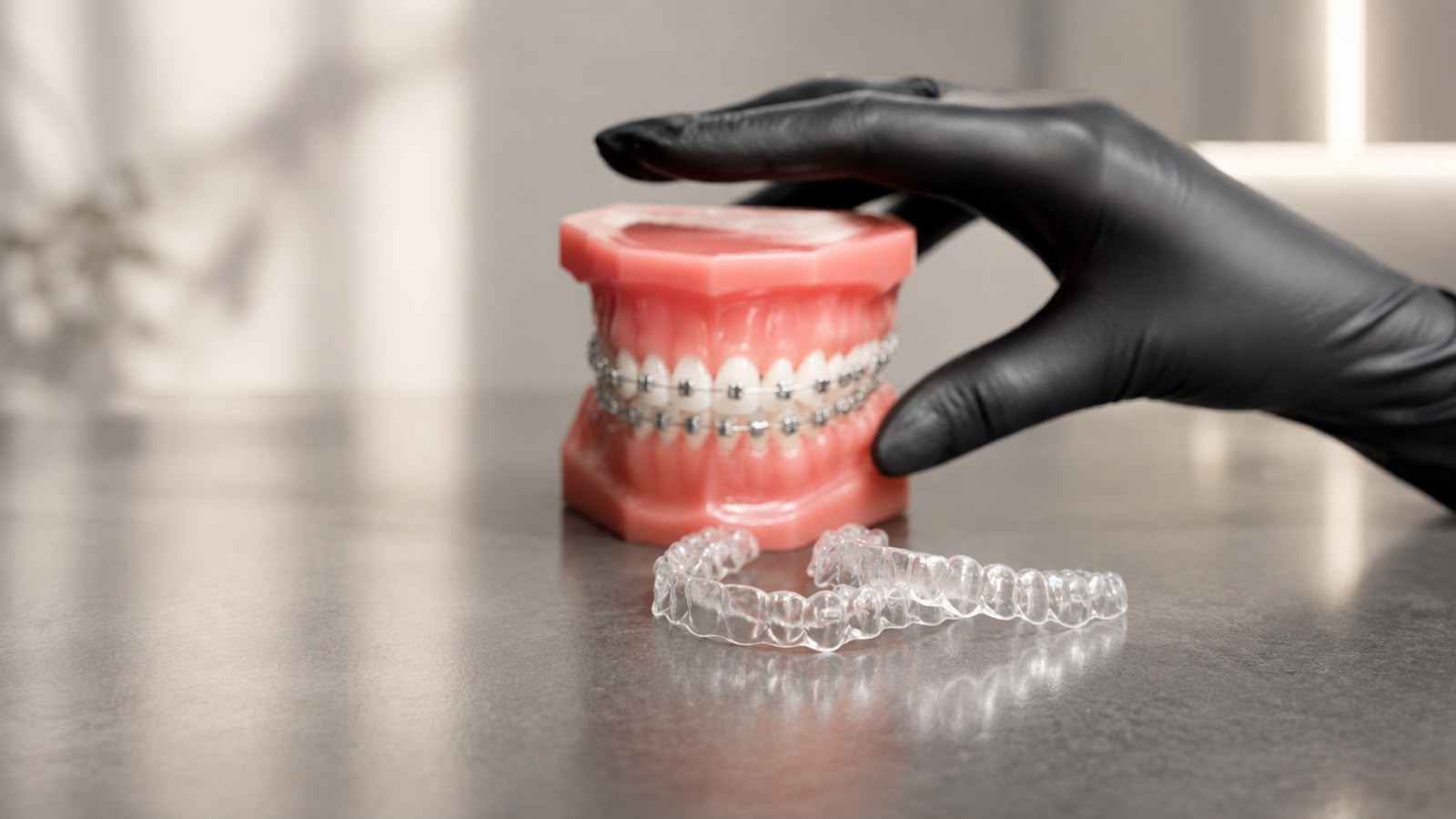
Fixed appliances — metal or ceramic braces — bond a bracket to each tooth and connect them with an archwire. The wire applies continuous, three-dimensional force to every tooth simultaneously, and because the brackets are attached to the teeth, the orthodontist has direct control over rotation, tipping, torque and vertical position. Additional mechanics — elastics, springs, auxiliary wires, temporary anchorage devices — extend that control further.
Clear aligners are a series of removable trays, each slightly different from the last, that apply pressure to move teeth incrementally toward a planned position. Force is delivered by the tray pressing against the tooth surface, which is a fundamentally different mechanism than a bracket-and-wire system, and it has different strengths.
That mechanical difference is the origin of every practical distinction below.
What aligners do well
- Mild to moderate crowding
- Spacing and gaps
- Relapse after previous orthodontic treatment, which is extremely common
- Tipping movements of teeth
- Cases where the patient is disciplined and the plan is well designed
They are also removable, which means eating without restriction and cleaning teeth normally. For adults with periodontal considerations, that hygiene advantage is genuinely clinically relevant, not merely convenient.
What fixed appliances still do better
- Rotating round teeth. Premolars and canines with cylindrical crowns are difficult for a tray to grip and rotate.
- Extrusion. Pulling a tooth further out of the bone is one of the hardest movements for an aligner, because a tray naturally pushes rather than pulls.
- Large movements and extraction cases. Closing substantial extraction spaces with bodily movement of teeth requires control that brackets provide more predictably.
- Significant bite corrections. Correcting how the arches relate to one another, particularly in adults, often requires mechanics that aligners alone do not provide.
- Molar uprighting and other complex individual tooth positioning.
Aligner technology has advanced considerably and now handles cases that would have been out of reach a decade ago. What has not changed is that the more complex the movement, the more the planning has to compensate — and the more the outcome depends on the orthodontist’s design rather than on the software’s default plan.
The parts nobody mentions until you have started
Attachments. Most aligner cases require small tooth-colored composite bumps bonded to teeth, so the tray has something to grip for specific movements. They are on your teeth for the duration of treatment. They are far less visible than brackets, but “invisible” is a marketing word rather than a clinical description.
Interproximal reduction. Creating space in crowded cases often involves polishing a fraction of a millimeter of enamel from between teeth. It is routine, minimally invasive, and it is enamel that does not return. It should be disclosed and consented to before treatment, not mentioned at the appointment where it happens.
Wear time. Aligners work when they are being worn, typically twenty to twenty-two hours per day, removed only for eating and cleaning. This is the single largest determinant of whether aligner treatment finishes on schedule. A patient who removes them for long stretches is not receiving a slower treatment. They are receiving an unpredictable one, because the teeth stop following the planned sequence.
Refinements. Most aligner cases require a second series of trays partway through, once teeth have deviated somewhat from the projected path. This is normal, not a failure, and it is worth asking in advance whether refinements are included in the quoted fee.
Ceramic braces, the option that gets skipped
Patients who reject metal braces on appearance frequently do not know ceramic brackets exist. They are tooth-colored, fixed, and deliver the full biomechanical control of a bracket-and-wire system. They are more visible than aligners and dramatically less visible than metal.
For a case that genuinely needs fixed mechanics but where appearance matters, this is often the honest recommendation, and it is often the one that never gets made because the conversation was framed as aligners versus metal from the beginning.
Duration and cost
Treatment duration is determined by the complexity of the movement required, not by the appliance. Mild cases in either system are commonly measured in months; comprehensive cases in both are commonly measured in a year and a half to two years. Your own imaging produces a specific estimate; a generic range does not.
Cost varies with case complexity and with the system. Aligner treatment is generally comparable to or above ceramic braces, and metal braces remain the most economical option for equivalent complexity.
The cross-border consideration
Orthodontics is the one treatment where crossing the border is a logistics question as much as a clinical one, because it requires periodic check-ins over a long period.
This is where aligners have a structural advantage. Trays can be issued in batches, progress can be monitored remotely between visits, and in-person appointments can be scheduled at intervals that suit a patient who is driving from San Diego rather than living down the street. Fixed appliances require wire changes and adjustments on a tighter schedule.
For a cross-border patient, this consideration sometimes outweighs a marginal biomechanical preference — and sometimes it does not, because a case that genuinely requires fixed mechanics is not improved by treating it with the more convenient appliance. That trade-off should be discussed openly rather than resolved silently.
Retention, which is not optional
Every orthodontic case ends here, and this is the part that patients most consistently underestimate.
Teeth move for life. The fibers around them retain memory of their original position, and jaws continue to change subtly with age regardless of what was done to them. Retention — a fixed wire behind the front teeth, a removable retainer at night, or both — is what makes an orthodontic result permanent.
Anyone who tells you otherwise is selling relapse.
Frequently asked
Can I switch from aligners to braces partway through?
Yes, and it happens. If a case is not tracking as planned, moving to fixed appliances is a legitimate correction rather than an admission of failure. What matters is that the possibility is discussed at the start, including what it would mean for cost.
Do aligners hurt less than braces?
Different sensation rather than clearly less. Aligners produce pressure and tightness for a day or two with each new tray. Fixed appliances produce soreness after adjustments and can irritate soft tissue. Neither is severe for most patients, and individual experience varies considerably.
Are cheaper mail-order aligners a real option?
They differ in a specific and important way: no in-person examination, no three-dimensional imaging, and no orthodontist monitoring the movement. Orthodontics moves teeth through bone, and periodontal health, root position and bite relationship all determine whether a given movement is safe. Those cannot be assessed from photographs.
How often would I need to come in as a cross-border patient?
For aligners, intervals are typically extended relative to a local patient, with remote monitoring between visits. The specific schedule is set at the treatment plan stage and should be in writing before you begin.
Will I need a retainer forever?
In some form, yes. This is not a sales position. It is what the evidence on post-treatment tooth movement shows.
Whether your case is an aligner case or a fixed-appliance case is determined by imaging and a bite analysis, not by preference, and knowing which one you are changes the whole plan. Our contact page is where that conversation starts.
Related reading: Invisalign and Orthodontics in Tijuana · Orthodontics in Tijuana · Veneers vs crowns